
Answer engine optimization helps you win the patients who are searching. But most of your future patients aren’t even searching yet.
At this year’s Healthcare Interactive Conference, answer engine optimization (AEO) was a major part of the conversation. As patients increasingly turn to AI-powered tools to research symptoms, compare providers and evaluate healthcare options, hospitals are thinking carefully about how they appear in those answers. The question is no longer just whether a health system ranks in search results, but whether AI will recommend it when someone asks where to go for care.
It’s certainly a worthwhile priority. Hospitals need accurate provider information, useful content and a strong digital presence to reach patients who are actively looking. But AEO primarily addresses the moment someone has a question or is evaluating care. What about everyone who isn't searching yet?
Consider someone who’s unhappy with their current physician but hasn’t looked for a replacement. Someone who hasn’t seen a doctor in years. Or a patient who’s perfectly satisfied with their current health system, even though another hospital is closer to home.
They’re all part of a hospital’s potential patient population, but their relationships with healthcare and their reasons for choosing a provider are very different. Reaching them before they search requires understanding what matters to them and what might influence their next healthcare decision.
What drives healthcare decisions?
Causeway models three priorities consumers consider when choosing healthcare providers: convenience, including proximity and ease of scheduling; quality, including physician expertise and outcomes; and connection, including compassionate care and the patient-provider relationship.
These audiences are developed through consumer survey research and predictive modeling across approximately 263 million U.S. adults. Nationally, connection is the most widely held priority at 62%, followed by quality at 44% and convenience at 42%. The priorities overlap, with about half of adults holding two or more.
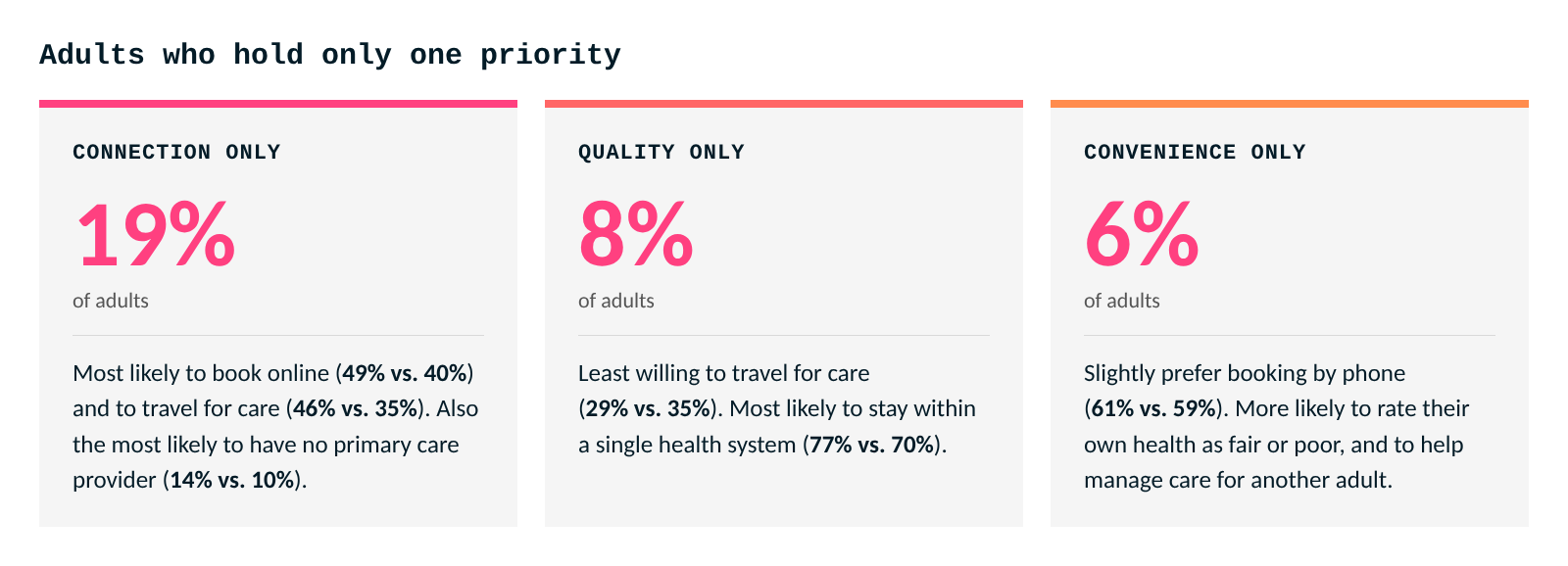
The differences become particularly interesting when we examine how these audiences interact with healthcare.
Consider the 19% of adults who prioritize connection alone. They value having a relationship with their provider, yet they’re also the most likely of the single-priority groups to have no primary care provider. They’re more willing to travel for care, more comfortable booking online and less attached to a single health system.
For hospital marketers, this represents an opportunity to reach people who may be receptive to a new provider, even if they aren’t actively searching. Messaging about compassionate care and continuity may resonate more than another advertisement about convenient locations.
Other audiences present different challenges. Among adults who value all three priorities, 91% saw a primary care provider in the past year, and 81% use one health system. These patients have stronger existing relationships, making retention and trust especially important. Meanwhile, the 18% who hold none of the three priorities are the least connected to care in our models and may require different outreach approaches altogether.
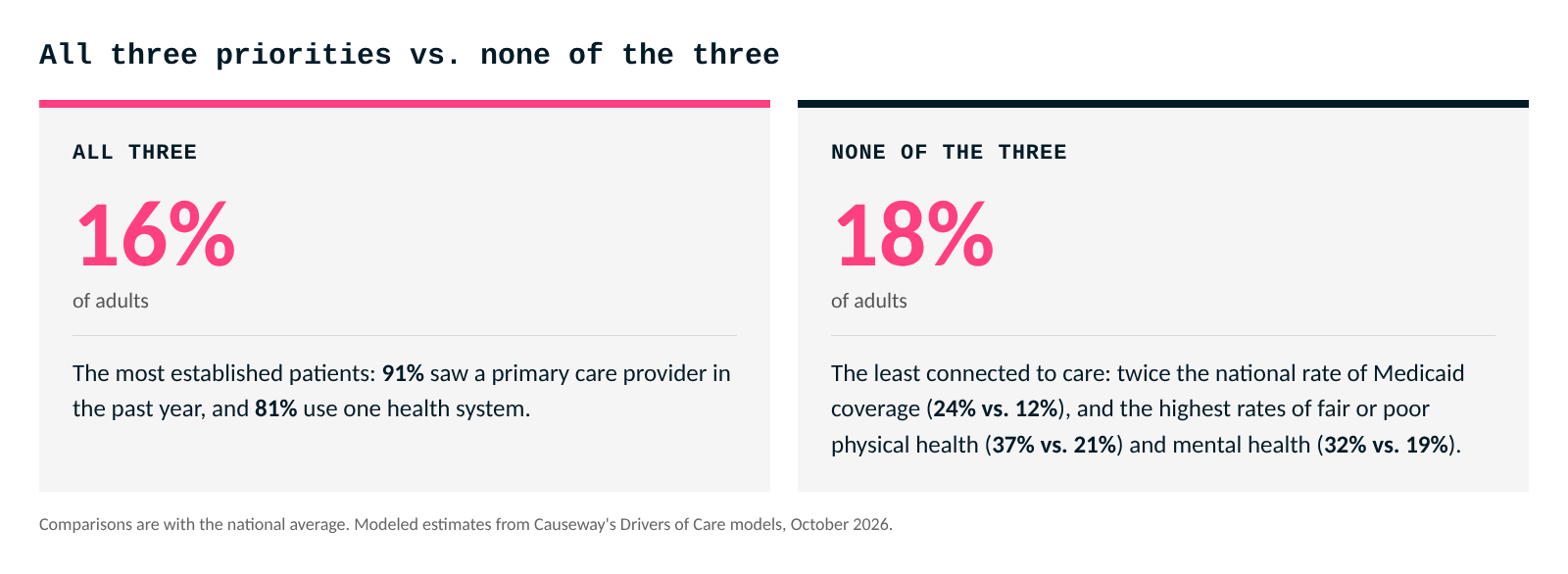
These findings illustrate why hospitals can’t rely entirely on patients identifying their own needs and beginning a search. Some potential patients may be open to changing providers but haven’t taken that step. Others have strong existing relationships, while some are less engaged with healthcare altogether. Understanding these differences helps marketers identify who they need to reach, what matters to those individuals and how to communicate with them before they’re actively looking.
AEO is part of the strategy, not the entire strategy
Hospitals should absolutely invest in AEO. Being visible and credible when someone asks an AI assistant for a provider recommendation is becoming an important part of healthcare marketing. But being the right answer when someone searches is only part of patient acquisition.
Hospitals also need to reach people who haven’t started looking, build familiarity with potential patients and strengthen relationships with those they already serve. Paid media, connected TV, direct mail and other outreach channels can help reach those audiences before they have an immediate need. Understanding their healthcare priorities makes that outreach more relevant.
For example, a hospital looking to grow primary care visits might reach connection-focused consumers with messaging about compassionate physicians and long-term relationships. An organization focused on retention might take a different approach with patients who already have strong provider relationships. And reaching people who are less engaged with healthcare may require outreach that addresses barriers to care rather than emphasizing traditional provider attributes.
The goal isn’t to choose between AEO and audience targeting. It’s to connect the two parts of the patient journey: building familiarity and consideration before someone needs care, and being visible when that person begins evaluating their options.
Before the search
As AI changes how patients discover healthcare providers, AEO deserves the attention it’s receiving. But a strategy focused entirely on search overlooks the people who aren’t asking questions yet.
Our research shows why those people shouldn’t be treated as one broad audience. Their priorities, relationships with providers and willingness to consider alternatives differ considerably. Understanding those differences gives healthcare marketers a way to reach beyond active search demand and develop more relevant strategies for patient acquisition and retention.
AEO helps hospitals become part of the answer when someone searches. Audience intelligence helps them become a meaningful option before the search ever begins. For healthcare marketers, the opportunity isn’t just to be recommended by AI. It’s to build awareness, trust and consideration with future patients before they need care.
Looking to reach patients before they search? Whether you're a health system, an agency expanding your capabilities or a brand looking to get more from your existing media strategy, let's talk about how Causeway can help.