
Key Points
Land use projects succeed or stall based on public perception, political alignment, and early community trust, not just economics.
Behavioral-based data helps teams distinguish supporters, persuadables, and immovable opponents, reducing wasted outreach and improving focus.
Combining sentiment and motivation insight with engagement likelihood creates clearer signal on where communication can actually move outcomes.
Land use development projects sit at the intersection of economics, politics, and community identity. Across the country, residents, and ultimately voters, are asked to weigh the promise of investment against its perceived costs.
Does a state-of-the-art sports stadium and surrounding retail district justify the use of public tax dollars?
Does a new convention center offset concerns about traffic, noise, and a changing community dynamic?
Does a data center’s tax revenue outweigh concerns about large-scale facilities that provide little direct benefit to local retail or entertainment ecosystems?
These are not abstract debates. They influence elections, shape political careers, and determine whether projects move forward or stall indefinitely. Whether the project is a professional sports stadium, a mixed-use development, or a large-scale data center, success is driven by public perception, political alignment, and the ability to shape community conversations early—and credibly.
At Causeway Solutions, we start with a simple belief: behind every data point is a person making a decision.
From Data Science to Decision Science
In many development battles, “data” is abundant—but insight is scarce. Advocacy efforts often default to broad messaging or reactive communications, responding to opposition narratives rather than understanding the underlying motivations driving them.
Causeway helps organizations move upstream. We apply behavioral science to uncover why different audiences respond the way they do, then translate those insights into focused, human-centered strategies. Not every supporter supports a project for the same reason. Not every undecided resident is persuaded by the same argument. And some opponents, no matter the message, are unlikely to change their position.
Recognizing these differences allows organizations to allocate time, attention, and resources with greater precision—and far less waste.
To support this work, Causeway layers proprietary behavioral models that estimate an individual’s likelihood of political engagement, such as contacting an elected official or participating in a public forum. When paired with sentiment and motivation data, this creates a clearer picture of where engagement can matter most—helping teams focus on activating supporters and thoughtfully persuading those who are open to engagement.
Stadium Advocacy: Navigating Emotion with Insight
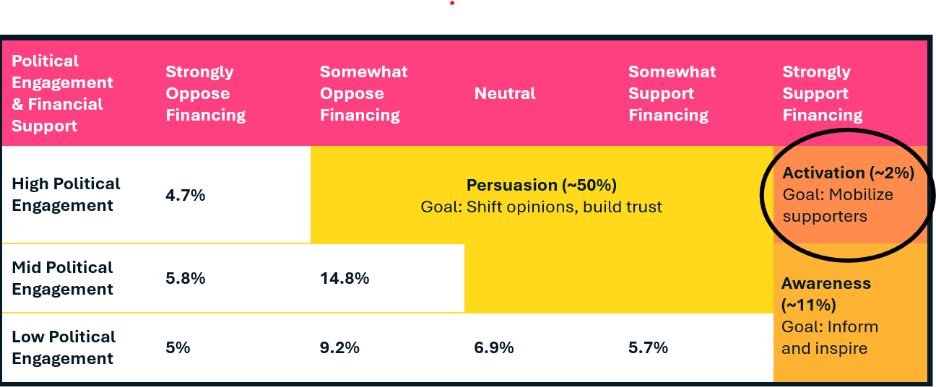
Figure: Mapping engagement vs. support to align strategy: inform, persuade, or mobilize
Publicly financed sports stadiums are among the most visible—and emotionally charged—land use projects. While fans may feel a strong connection to a team, that connection does not automatically translate into support for public investment.
These decisions are inherently complex. While Causeway cannot simplify the decision itself, we help simplify how organizations navigate shifting public sentiment. By identifying where support already exists, where reassurance is needed, and how opinions evolve over time, we help campaigns communicate with greater clarity and relevance—meeting people where they are, rather than where assumptions place them.
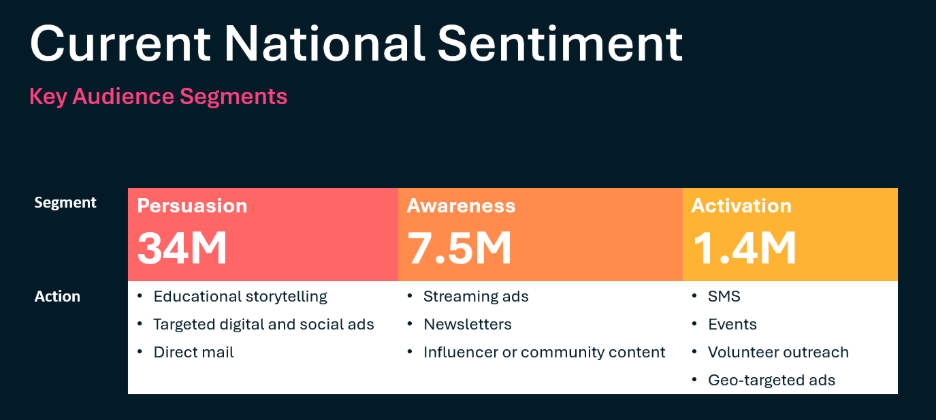
Figure: Different segments require different tactics
Data Center Development: Engaging Communities Early
Data centers represent one of the fastest-growing areas of land use development. Across the country, communities are raising concerns about energy use, environmental impact, and infrastructure strain. These concerns are reshaping local political conversations and forcing developers and policymakers to rethink how they engage the public.
Causeway works with developers, municipalities, and advocacy organizations to identify where concerns are emerging, which issues resonate most, and which audiences remain open to dialogue. By combining sentiment analysis with behavioral engagement indicators, we help organizations engage civic-minded residents, business leaders, and local influencers early—before uncertainty hardens into opposition.
Making Complexity More Navigable
Land use decisions are rarely simple. They involve trade-offs, competing priorities, and deeply held values. But experience shows that projects move more smoothly when people feel heard, informed, and meaningfully engaged.
At Causeway, we turn complex behavioral data into clear, actionable insight—helping clients anticipate challenges, build trust, and engage the right voices at the right time. We don’t just observe public conversations; we help organizations understand the human dynamics shaping them.
In today’s polarized and highly localized political environment, smarter data isn’t about saying more.
It’s about seeing more clearly—and making better decisions because of it.
About the Author
Tim Lolli is Director of Sports Strategy and Growth at Causeway Solutions, where he helps organizations navigate public sentiment and stakeholder dynamics using behavioral-based insight. His background spans high-pressure campaign environments and complex, multi-audience strategy work.
If you’re navigating a land use project and want to strategize, reach out to Tim directly: tim.lolli@causewaysolutions.com
Source: Consumer modeling and behavioral insights based on proprietary Causeway Solutions data, 2025.
The views and insights expressed are informed by Causeway Solutions’ proprietary modeling methodologies. Models leverage privacy-safe data and advanced analytics to generate audience insights. Specific methodologies are confidential and not publicly disclosed.