
What you can learn when you look past the shopping cart
Every November, holiday shoppers get sorted into two neat piles. There are the deal seekers: up early, coupons stacked, tabs open on three retailers at once. And there are the luxury shoppers, who know what they want and aren't waiting for a doorbuster to get it.
It's a tidy story. The data tells a messier one.
Our national data covers 267 million U.S. adults, and when you look at how they actually shop, the line between "bargain" and "premium" is a lot blurrier than most holiday media plans assume.
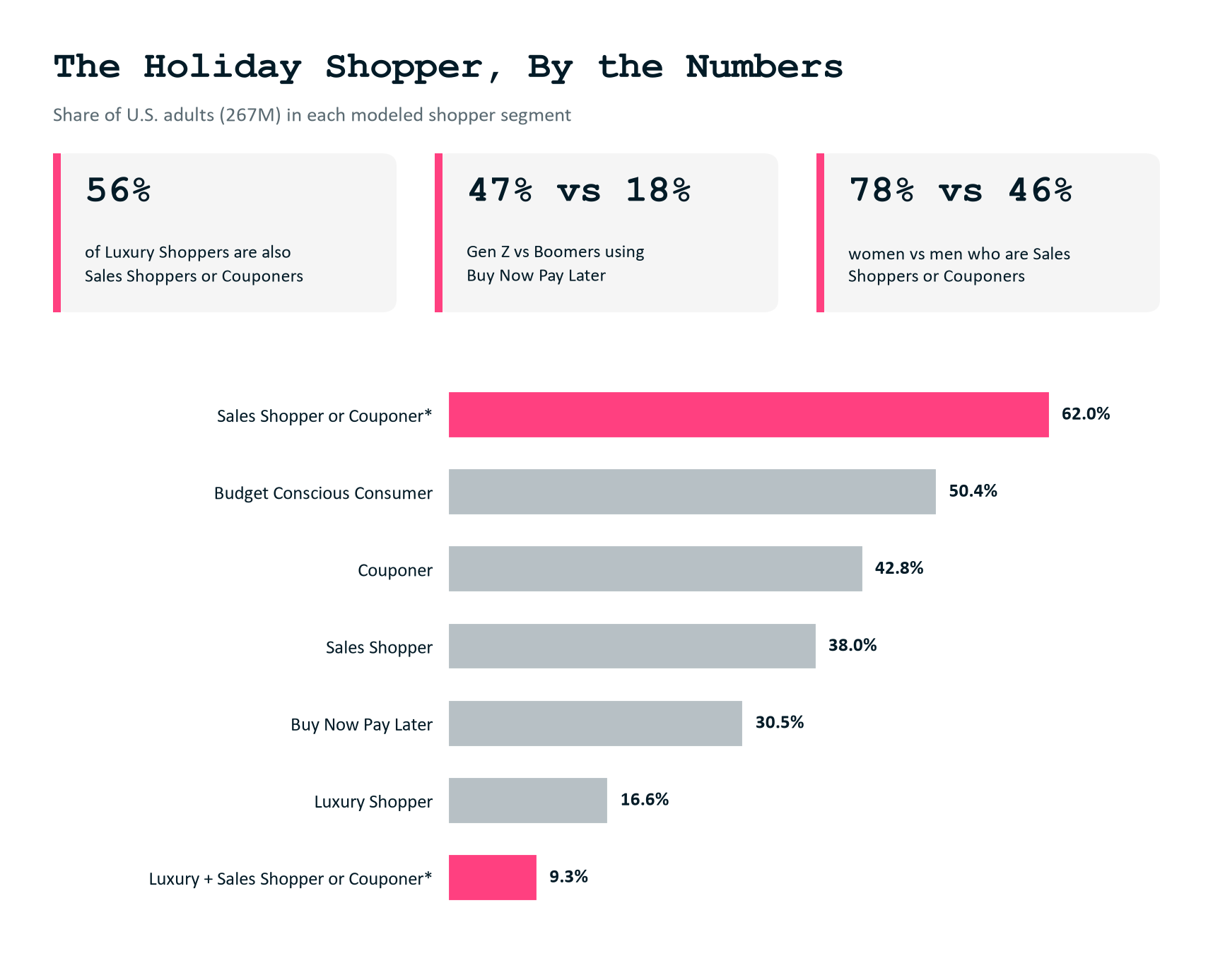
Source: Causeway Solutions Audience Intelligence, national modeled consumer segments. *Combination of two segments. Segments overlap and are not additive.
Most Americans are chasing a deal
42.8% of U.S. adults index as Couponers and 38.0% as Sales Shoppers. Combined, 62% fall into at least one, while only 16.6% index as Luxury Shoppers. None of that is surprising on its own. The interesting part is what happens at the other end of the spectrum.
More than half of luxury shoppers are chasing deals too
56% of Luxury Shoppers also index as Sales Shoppers or Couponers. The person buying the premium handbag may also be the person waiting for the code to drop. Premium taste and bargain behavior aren't opposites; for many shoppers, they live side by side.
For a marketer, that changes the question. It's no longer "is this person a bargain shopper or a luxury buyer?" It's "what would get this person to buy now instead of later?"
The label tells you what someone likes. The behavior tells you what moves them.
Luxury shoppers are buying experiences, not just things
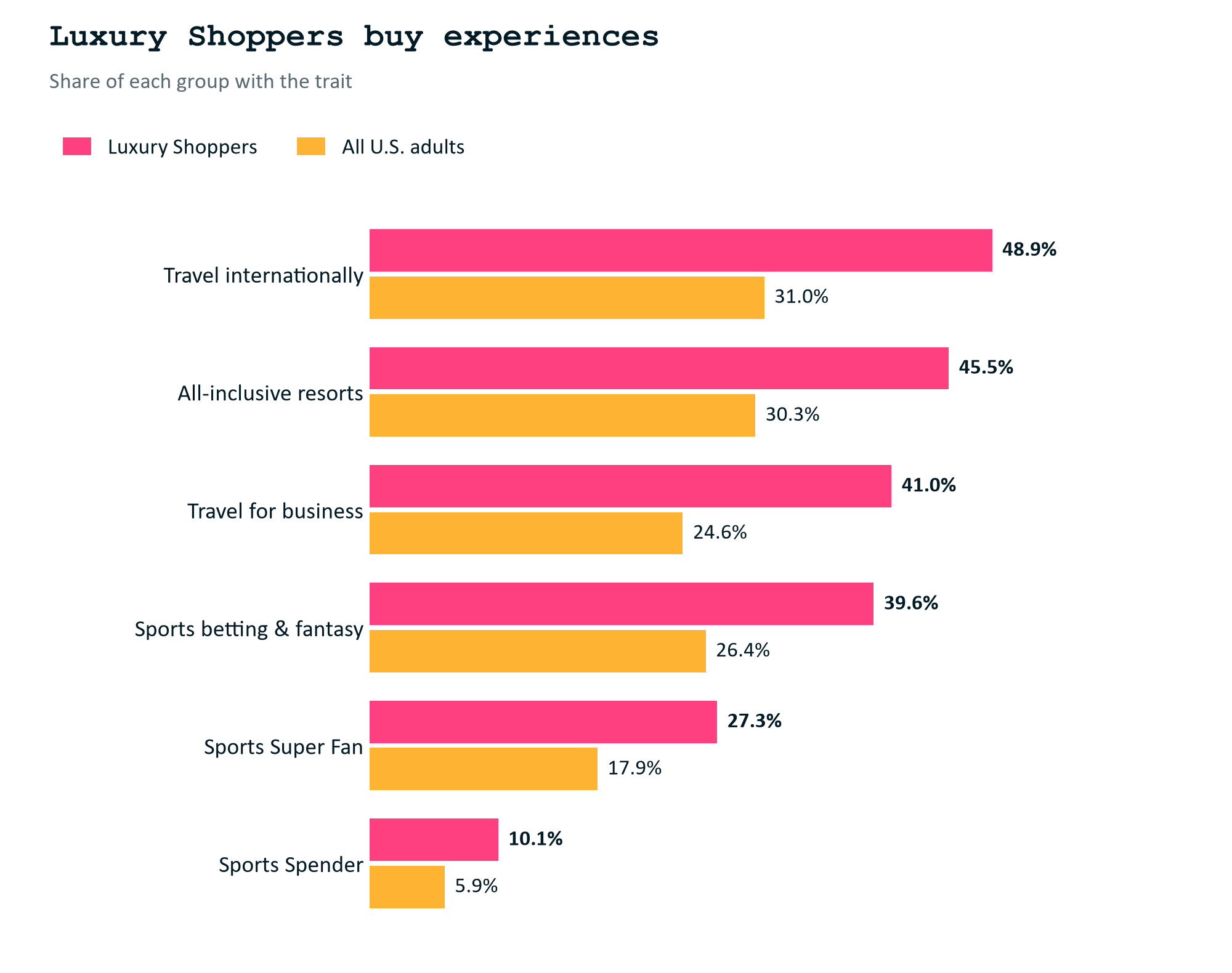
Compared with U.S. adults overall, Luxury Shoppers are far more likely to:
Travel internationally: 48.9% vs. 31.0%
Travel for business: 41.0% vs. 24.6%
Book all-inclusive resorts: 45.5% vs. 30.3%
Qualify as sports Super Fans: 27.3% vs. 17.9%
Participate in sports betting and fantasy sports: 39.6% vs. 26.4%
Source: Causeway Solutions Audience Intelligence, national modeled consumer segments
They're also nearly twice as likely to be Sports Spenders on tickets, travel, and merchandise (10.1% vs. 5.9%). With the holidays landing in the middle of football season, bowl games, and the NBA calendar, a premium brand may find its buyer more easily during the game than in the circular. One more detail that breaks the stereotype: Luxury Shoppers are more likely to drink beer (58.0%) than wine (47.1%).
Buy Now, Pay Later isn't just a budget tool
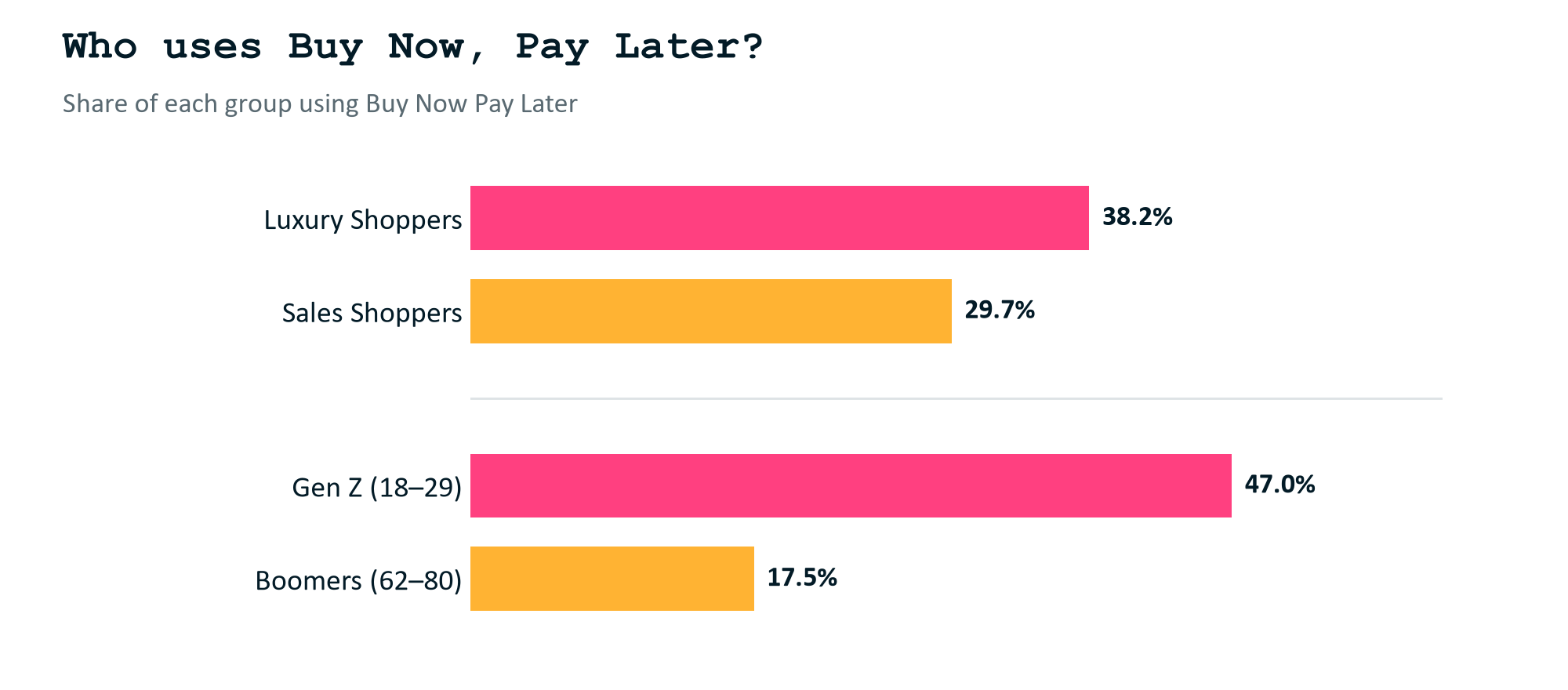
You might expect payment plans to be a bargain shopper's move. Instead, 38.2% of Luxury Shoppers index as Buy Now, Pay Later users, compared with 29.7% of Sales Shoppers.
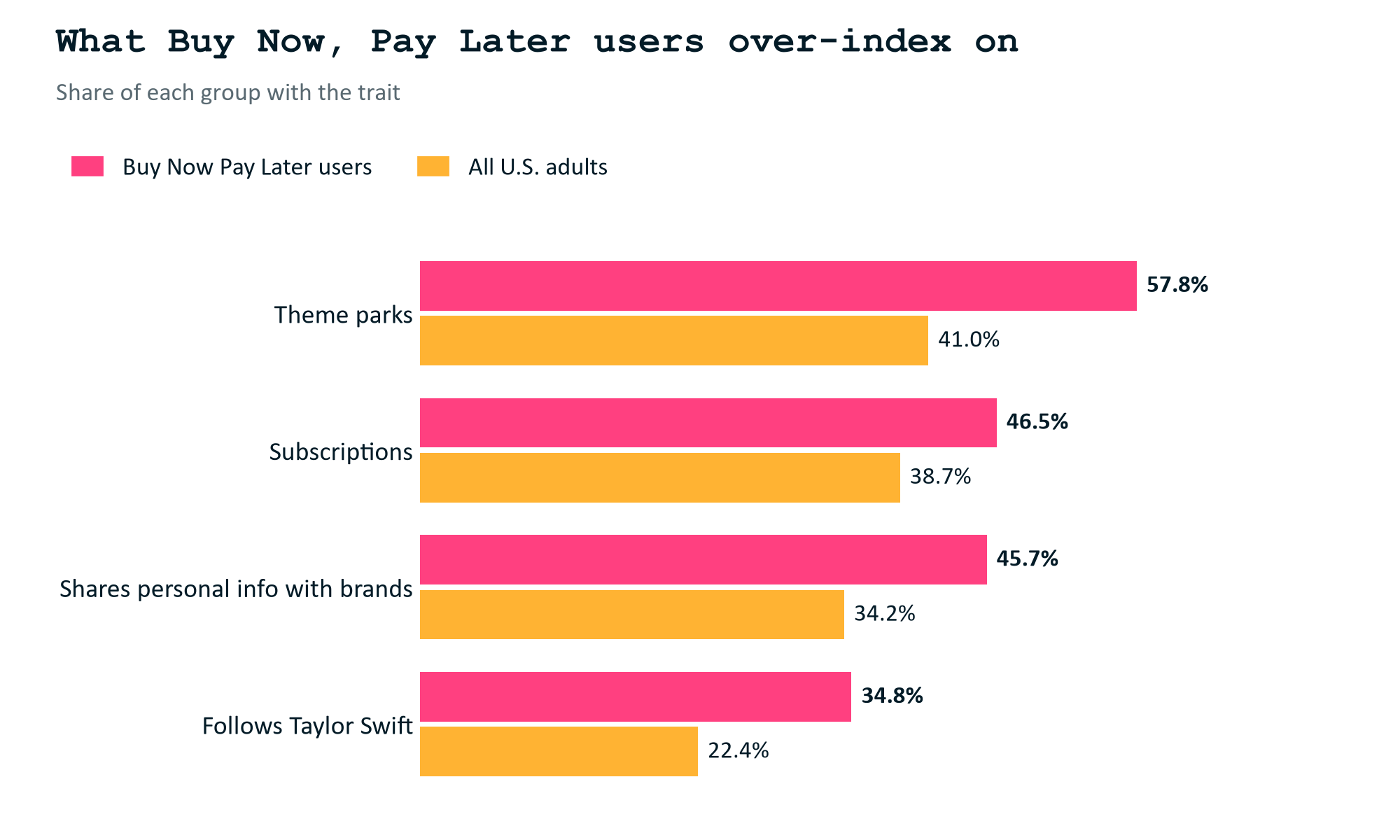
The audience skews young, with a median age of 43 versus 54 for U.S. adults overall. 47% of Gen Z adults use it, nearly three times the rate of Boomers (17.5%), and unlike almost every other behavior we looked at, it shows no gender gap. These users also over-index on theme parks (57.8% vs. 41.0%), subscriptions (46.5% vs. 38.7%), and following Taylor Swift (34.8% vs. 22.4%).
Source: Causeway Solutions Audience Intelligence, national modeled consumer segments. Age based on matched records; generation ranges are approximate
Most useful of all, 45.7% are likely to share personal information with a brand, compared with 34.2% of adults overall. In a season built around big-ticket gifts, the offer that closes the sale may be a payment option rather than a discount, and the shopper who takes it may be the one most willing to become a known customer.
Source: Causeway Solutions Audience Intelligence, national modeled consumer segments
The biggest gap isn't age. It's gender.
77.9% of women index as Sales Shoppers or Couponers, compared with 46.2% of men. Luxury reverses the pattern: 23.1% of men index as Luxury Shoppers, compared with 11.1% of women.
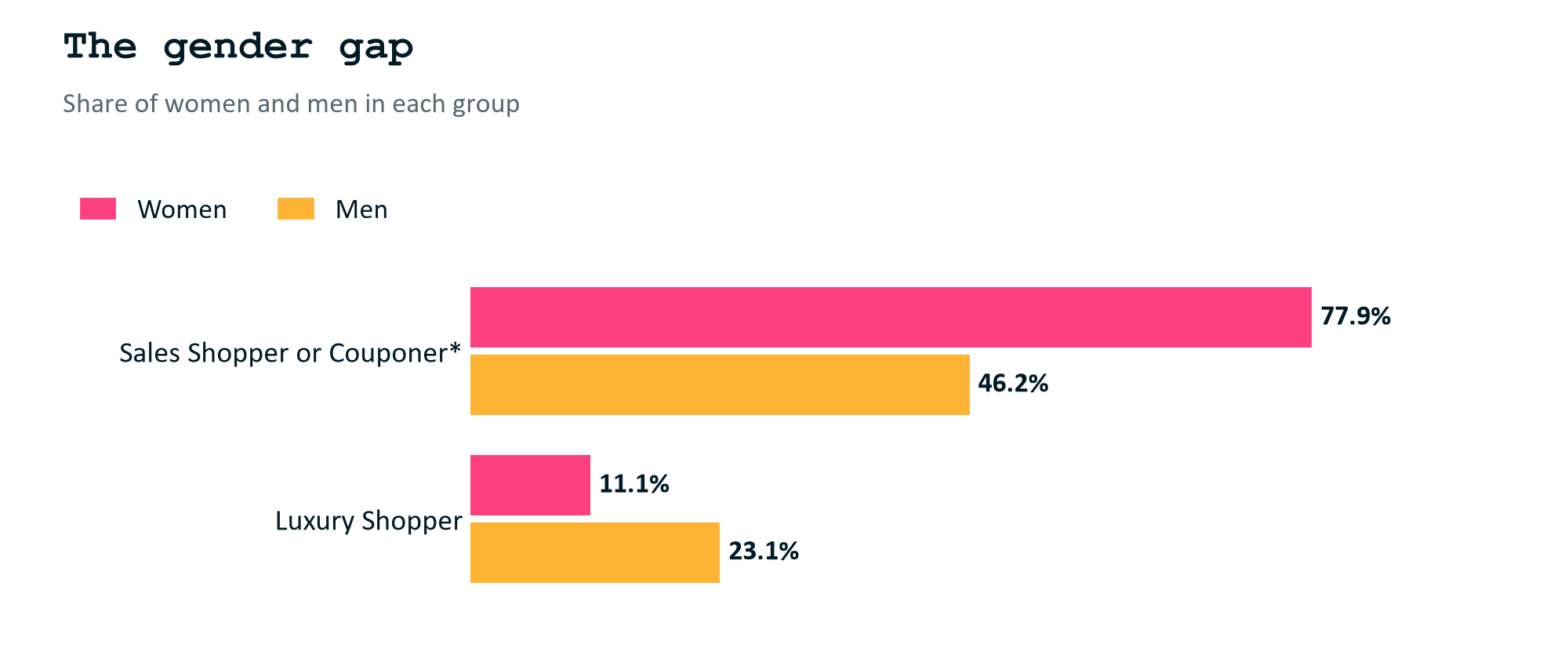
Source: Causeway Solutions Audience Intelligence, national modeled consumer segments. *Combination of two segments. Gender based on matched records
The gap holds in every generation. Millennial women are the most budget-conscious group we measured (75.1%) and the most likely to coupon (61.1%), while Millennial and Gen Z men are the most likely to be Luxury Shoppers, at roughly 27%. Not every woman is clipping coupons and not every man is buying premium, but a single "holiday shopper" creative strategy is likely talking past a large part of the audience.
Couponing is the one habit that doesn't care where you live
Geography changes almost everything else. Luxury shopping doubles from rural to urban areas (10.5% to 21.7%), Buy Now, Pay Later climbs from 26.4% to 36.4%, and budget consciousness moves the other way, from 56.3% in rural areas to 47.6% in cities. Couponing barely moves, holding at roughly 43% in urban, suburban, and rural areas alike.
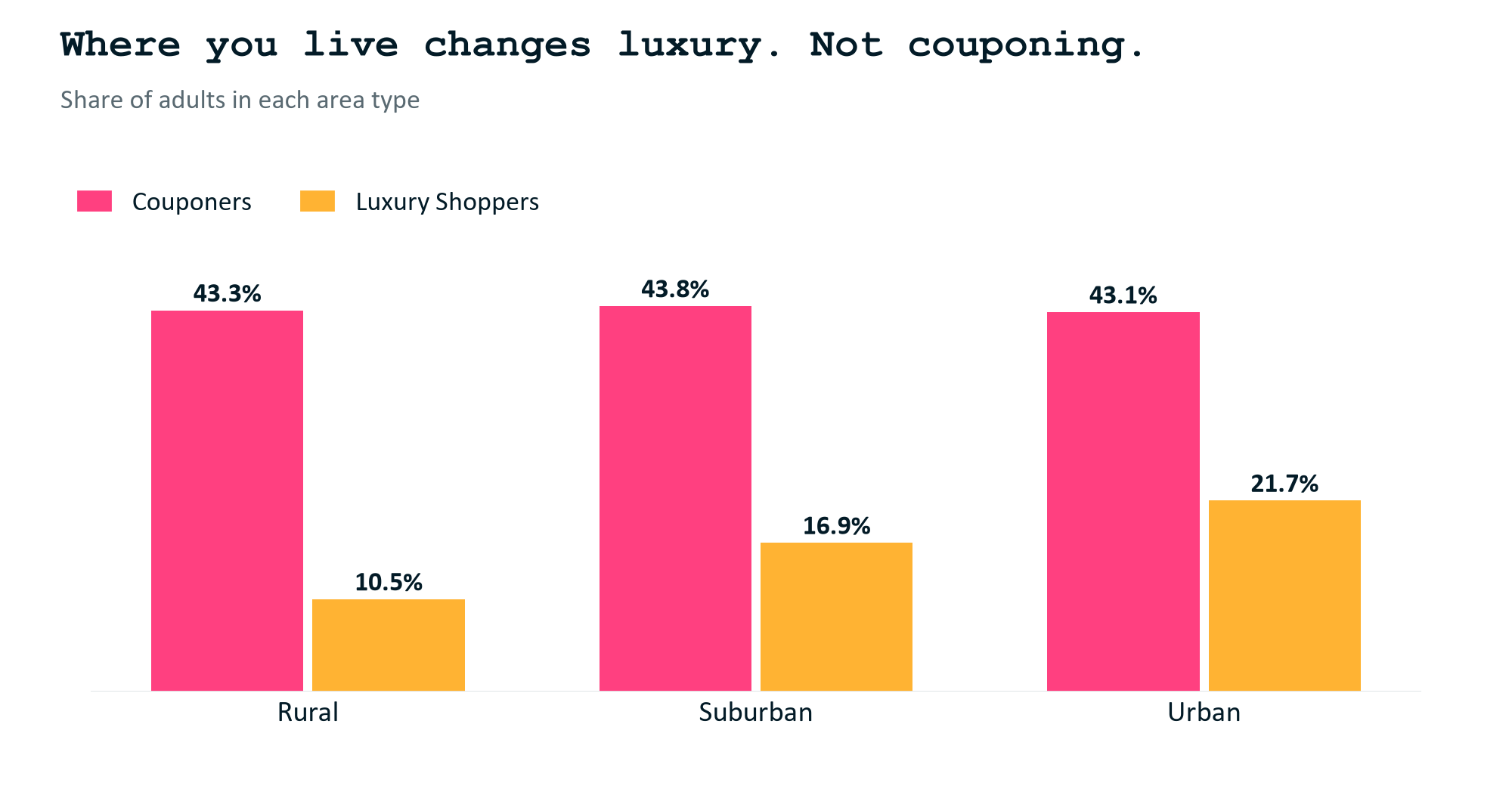
Source: Causeway Solutions Audience Intelligence, national modeled consumer segments. Urbanicity based on matched records
State by state, sales shopping and couponing peak in Vermont (64.3%) and Pennsylvania (64.1%), luxury shopping peaks in Hawaii (28.3%) and California (26.1%), and Washington, D.C. leads the country in Buy Now, Pay Later at 46.7%. A national holiday campaign is really fifty-one smaller ones.
But the coupon works everywhere.
What a holiday shopper looks like inside
These aren't separate audiences, and they aren't meant to be added together. They're overlapping characteristics within the same 267 million-person U.S. adult audience.
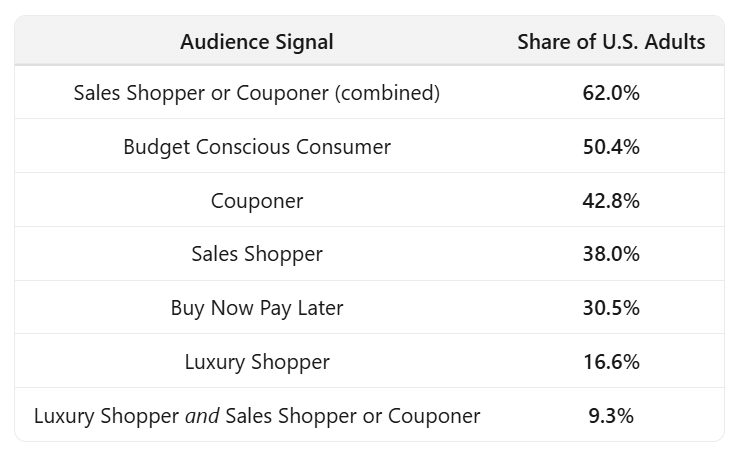
"Holiday shopper" is a useful starting point, but on its own it can't tell you whether someone will respond to a discount, a payment plan, a premium message, or a placement during the game. Layer in shopping behavior, payment preference, age, gender, geography, and interests, and the label splits into real decisions: who needs a deal to act, who needs flexibility at checkout, who's premium but still price-aware, and where each of them is spending their attention this season.
Everyone's shopping this season. The data tells you how they'll decide.
Data segments referenced: Lifestyle > Spending Habits (Sales Shopper, Couponer, Budget Conscious Consumer, Luxury Shopper, Buy Now Pay Later); Sports (Sports Fan, Super Fan, Sports Betting and Fantasy Sports, Sports Spenders); Travel & Lodging; Food & Beverage; Social Media; Likely to Give PII to Brand. "Sales Shopper or Couponer (combined)" is a combination of two segments, not a standalone segment. Available through audience marketplaces.