
84% of Sports Fans Stream. But How Many Can Your Ads Actually Reach?
Your streaming ads may be missing the sports fans you actually want to reach
Key Takeaways
Streaming viewing isn’t streaming ad reach. 84% of sports fans stream, but only 44% regularly watch the big ad-supported tiers.
Casual fans are the hardest to reach through streaming. One in five watches live TV but not streaming, and only 35% are modeled ad-tier viewers.
A streaming-only plan favors the fans brands may need least. It reaches committed fans efficiently and under-delivers on casual fans, often the growth audience.
Define the audience before you choose the channels. Broad “sports fans” look like everyone else; the gaps only show up once you segment.
Picture two people watching the same championship game. One has followed the team all season, watches highlights during the week and rarely misses a game. The other couldn’t name five players on the field but tuned in because it’s a big event and their friends are watching.
Both count as sports fans. But for brands trying to reach new customers beyond the most dedicated audience, the second viewer is often the bigger opportunity. Causeway Solutions’ October 2026 analysis shows casual fans are also more likely to fall outside streaming: one in five watches live TV but doesn’t stream.
That makes knowing someone is a sports fan a poor guide to where to reach them. With football underway, baseball heading toward the World Series and basketball returning, a media plan built mostly on streaming will reach the committed fans efficiently and miss many of the casual ones.
How many sports fans can streaming ads reach?
Streaming accounted for 49% of all U.S. TV viewing in July 2026, according to Nielsen’s The Gauge. Among sports fans, streaming is close to universal: 84% are modeled as likely streaming viewers.
Being reachable through streaming advertising is a different matter. Only 44% of sports fans are modeled as regularly watching an ad-supported tier on Netflix, Disney+, Hulu, Paramount+ or Peacock. A fan on an ad-free plan, or on a service you aren’t buying, is a streaming viewer your buy can’t reach.
Counting Prime Video, which now shows ads by default, raises the share of sports fans with an ad-supported streaming signal to 70%. That still leaves about 42 million sports fans with no modeled ad-supported signal on the services we examined. Other services and ad opportunities exist, but the gap shows why streaming viewership alone doesn’t tell you how much of your audience a given buy will reach.
How do casual fans differ from super fans?
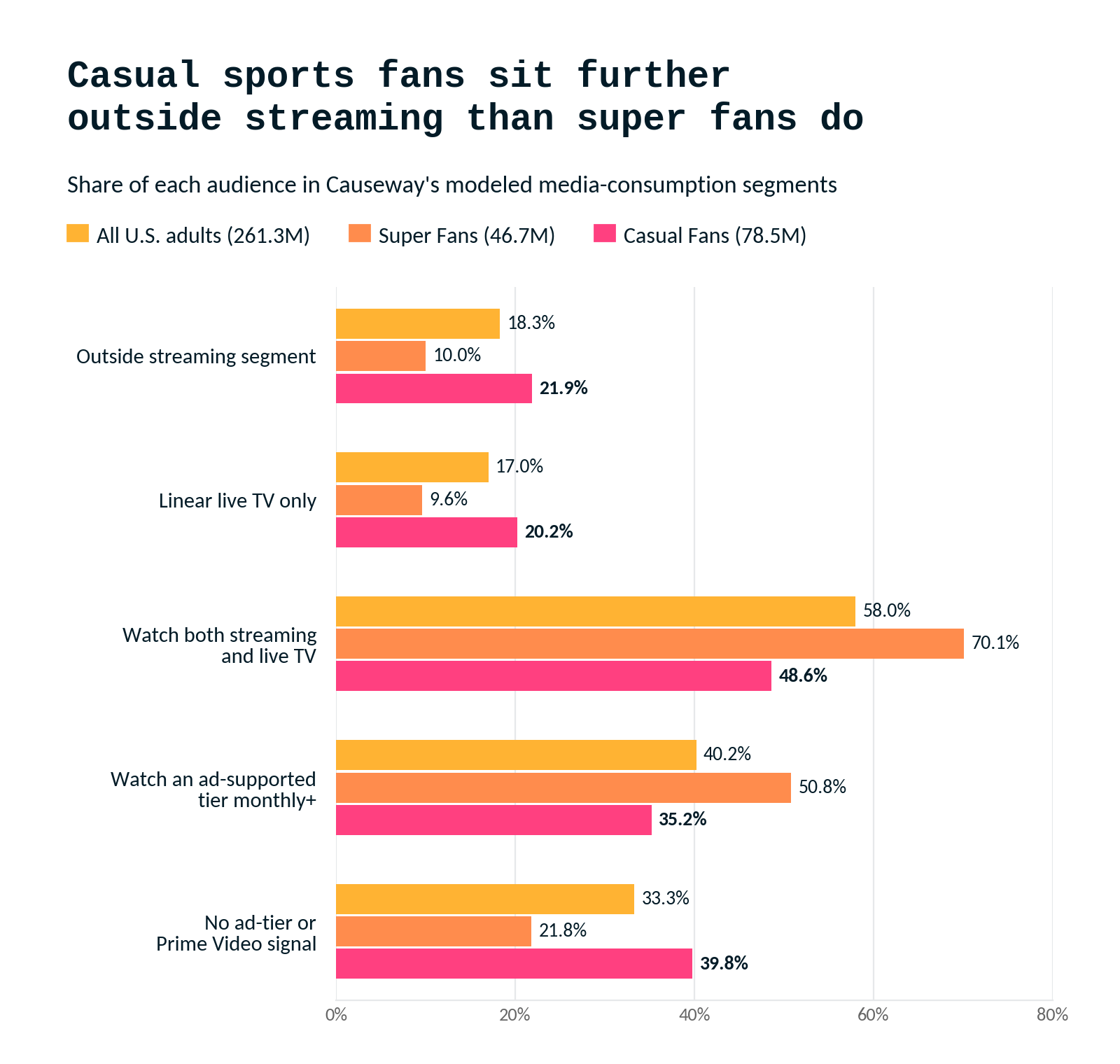
Source: Causeway Solutions modeled audiences, September 2026. Shares of each audience named; audiences overlap. Last row excludes Prime Video viewers. See methodology below.
Super Fans, a 47 million-person audience, are highly engaged with streaming. Only 10% fall outside Causeway's streaming segment, and 70% watch both streaming and live TV. They're also more likely than the average U.S. adult to watch ad-supported streaming services.
Casual Fans tell a different story. Among this 79 million-person audience, nearly 22% fall outside streaming altogether, and one in five watches traditional live TV but not streaming. Even when Prime Video is included, approximately 40% have no modeled ad-supported streaming signal, nearly twice the share among Super Fans.
The difference isn't simply that Casual Fans stream less. Their viewing habits are more divided, with fewer watching both streaming and traditional television. For advertisers trying to reach occasional viewers around major sporting events, those differences can influence how budgets should be allocated across channels.
Casual fans may be particularly valuable to brands looking beyond the most dedicated sports audience. Someone who tunes in only for the playoffs, World Series or a championship run may still be an ideal prospective customer for a food brand, automaker or healthcare organization. A streaming-only plan may align well with the habits of dedicated fans while overlooking a larger share of the casual audience a brand is trying to reach.
They aren't hard to reach. They're somewhere else.
Live TV is an obvious consideration for the one in five casual fans who watch traditional television but not streaming. Social media offers another potential opportunity. Among Casual Fans in that linear-TV-only group, 93% are modeled as using Facebook or YouTube.
That doesn't guarantee those consumers can all be reached through paid advertising on either platform, but it demonstrates why media-consumption behaviors matter when deciding where to invest.
None of this is an argument against streaming. Connected TV, traditional television and social media each have a role depending on the audience a brand wants to reach. The mistake is assuming that because a channel is popular with sports fans overall, it's necessarily the best way to reach the specific consumers a brand needs.
Build the audience before you buy the media
Broad audiences hide the differences that matter. On most of these measures, sports fans as a whole look similar to the general U.S. adult population. The casual fan gap only shows up once the audience is defined more precisely.
That’s how we approach this work at Causeway Solutions. We combine survey research, consumer data and predictive modeling to define audiences first, build their segments in Audience Builder, and then layer media-consumption intelligence on top to understand how those segments divide across streaming, linear TV and social media before the budget is set.
Because the audience is defined independently of any one advertising platform, the same definition carries across every channel, instead of each platform deciding who counts as your target.
The question isn't whether sports fans stream. It's how many you're missing if streaming is the only place you're advertising.
About the research
Causeway Solutions conducted this analysis in October 2026 using its September 2026 national consumer file of 261.3 million deduplicated U.S. adult records. Media behaviors were modeled using machine learning trained on 2025 national survey responses combined with consumer data.
Percentages reflect shares of the stated audience. “Streaming viewers” are those modeled as watching often or sometimes; “outside streaming” includes everyone else. “Ad-supported tier” reflects modeled monthly viewing on Netflix, Disney+, Hulu, Paramount+ or Peacock, with Prime Video included separately in the expanded measure.
Audiences may overlap, and percentages are not additive. Findings reflect modeled likelihoods, not verified viewing, ad exposure or campaign reach. Ad-supported viewing does not guarantee advertising availability or delivery.
Source: Nielsen, The Gauge, July 2026.