
The two questions that decide where your budget belongs.
Most media plans assume people who look alike will behave alike. They don't. Two people can share every demographic characteristic your targeting relies on and still produce completely different outcomes. They can be the same age, live in the same ZIP code, earn the same income, and fit every demographic definition a media plan usually relies on, but can still be worth completely different amounts of your budget.
One is genuinely open to what you're offering and consistently follows through. The other made up their mind long ago and is unlikely to change. Traditional audience definitions treat those two people as interchangeable, and that assumption shapes how millions of marketing dollars are spent.
Most audiences are still built around who people are. The more useful question is how they are likely to behave, and it comes down to two ideas: can they be moved, and will they act?
Can they be moved?
The first question is whether someone can be moved. Not whether you can reach them, whether reaching them changes anything. Every audience is full of people who have already decided. Some are loyal to you. Some are committed elsewhere. Some just have habits they will not break. Reach them and the campaign looks successful, because impressions land, but nothing actually changes, because there was nothing left to persuade. Movability is what separates the people you can influence from the people you can only measure.
Will they act?
The second question is whether they will act. Being open is only half of it. Someone who is both open and dependable usually needs little more than the right message. Someone who is open but inconsistent needs reminders, incentives, repeated engagement before behavior actually shifts. Those two audiences can look identical inside a traditional targeting model, and they require completely different levels of investment.
The grid tells you where the budget goes
Here's what happens when you place both questions on a simple map. Every audience falls into a recognizable pattern, and each quadrant implies a different move before a single dollar is spent.
Where The Budget Goes: Can they be moved, and will they act?
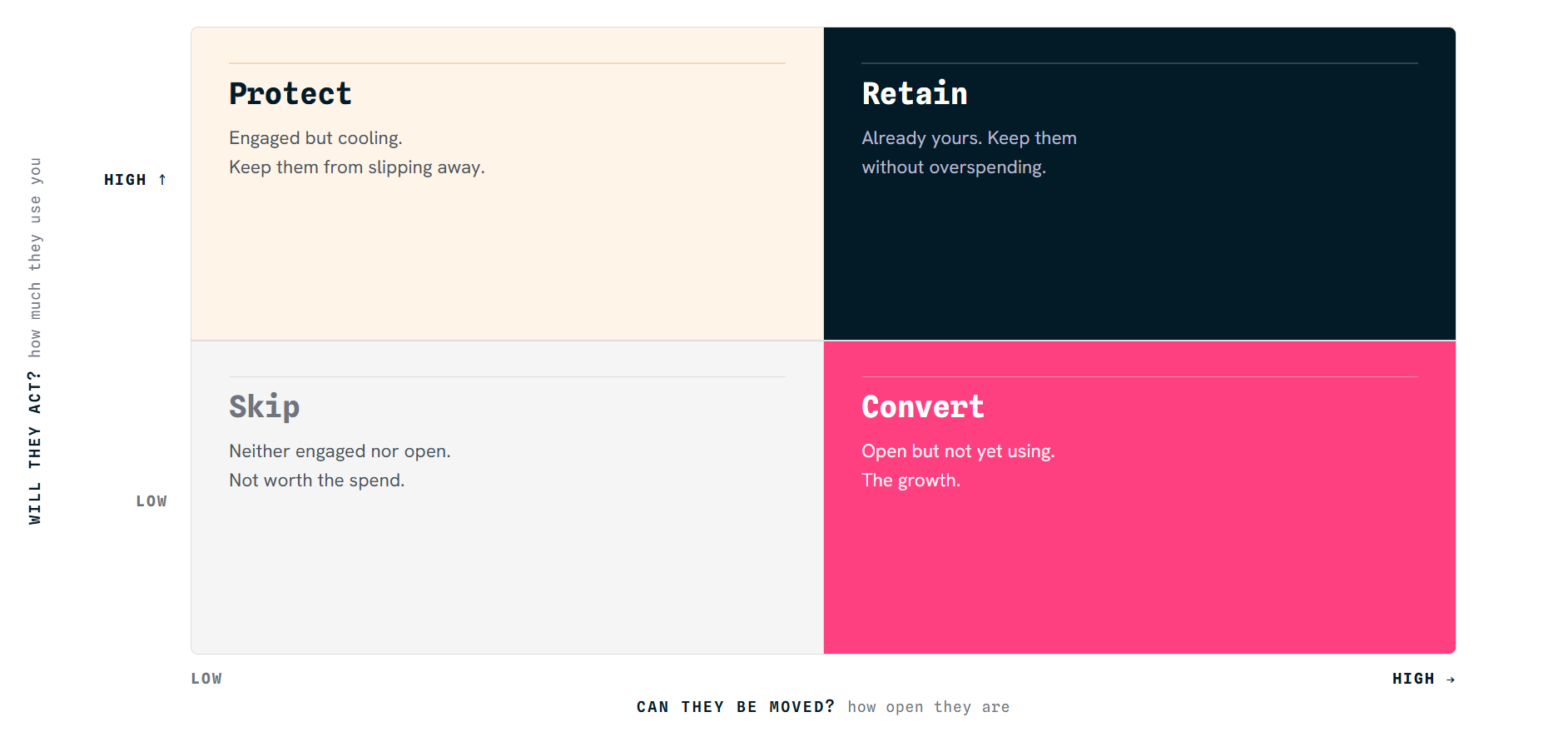
A simplified representation of the framework. In practice, each axis is divided into finer behavioral segments, creating a more precise view of where audiences fall. The principle remains the same: every segment is evaluated by how open people are to change and how likely they are to act, allowing budgets to be allocated with much greater precision.
People already with you and likely to act should be maintained, not persuaded. People who are both open and likely to act are your clearest path to growth. People who are open but unlikely to act deserve investment, but the work is activation, not persuasion. And people who are neither open nor likely to act may pad your reach, but they rarely justify another dollar of persuasion. A demographic profile cannot tell those four groups apart. A behavioral one can.
What it looks like in practice
We recently applied both questions to a market of more than 1.3 million people for a regional health system. Instead of asking only who these people were, we asked how much they already used the organization and how open they were to using it more. The priorities changed immediately.
The loyal, already-engaged patients, the group most organizations instinctively prioritize, turned out to be just 3 percent of the market. Worth keeping, but nowhere near the biggest opportunity for growth. Another 20 percent sat in the middle: moderate usage, moderate openness, an audience worth developing before asking for a bigger commitment. And 35 percent showed low current usage but high openness. Not disengaged. Just undecided.
Then one group inside that 35 percent stood out. More than 112,000 people showed strong openness to choosing the health system while barely engaging with it today. That single audience, invisible on a demographic profile, was the largest opportunity in the entire market to turn potential into growth.
Behavioral Opportunity Map: 1.3-Million Person Market
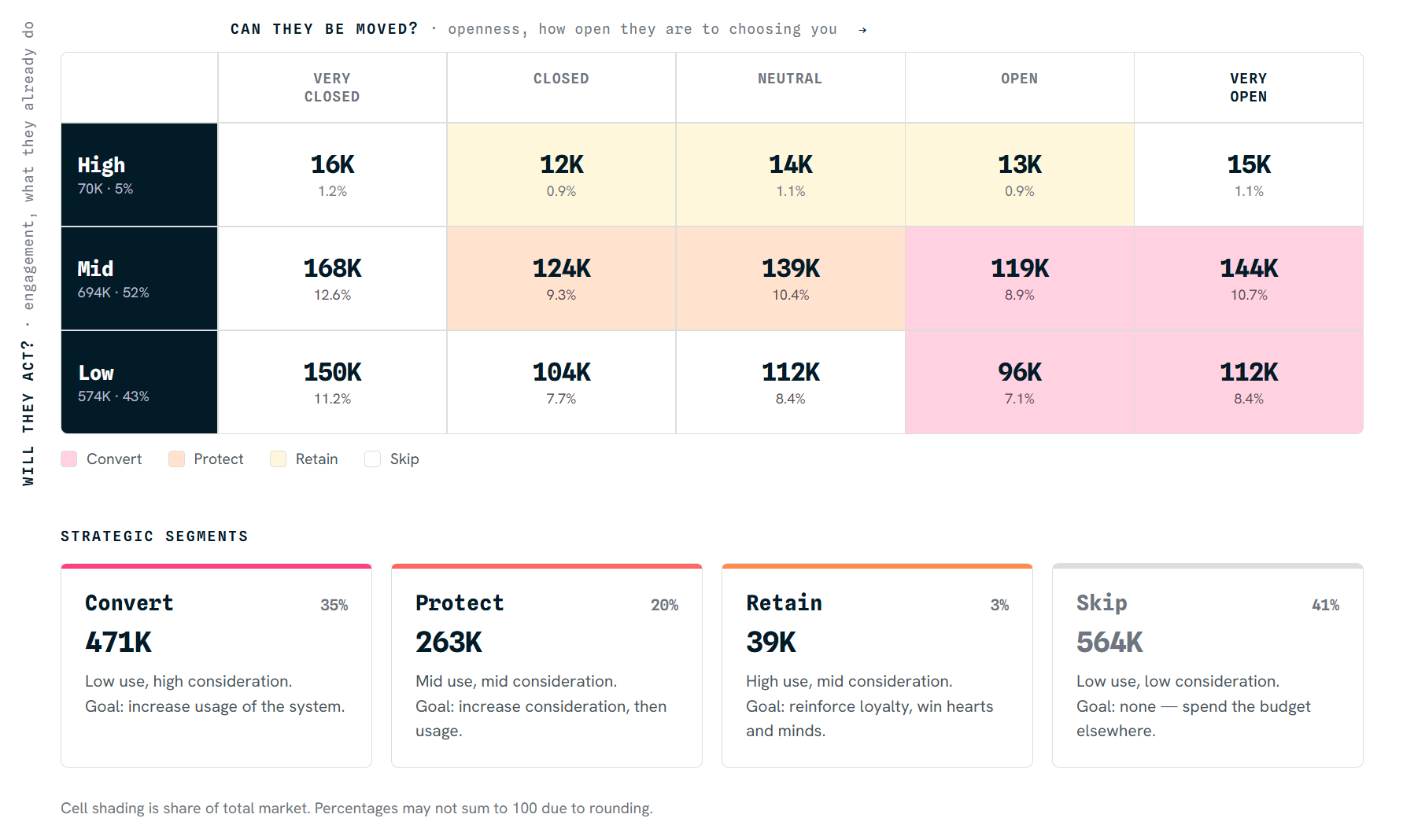
The expanded grid, and the full framework.
Without this framework, each of those groups would have looked like a reasonable target inside a traditional profile. Once they were sorted by movability and likelihood to act, the spending priorities became obvious.
Why this matters before the plan, not after
The reason to build an audience this way is timing. Most measurement happens after launch, when you can finally see what worked but can no longer change anything. Sorting by movability and likelihood to act happens before the budget is committed, while the findings can still bend the strategy.
And the discipline travels. Whatever you are trying to influence, whether a purchase, a provider choice, a membership renewal, or a vote, the mechanics change with the audience, but the discipline remains the same. The people who can be moved and are likely to act deserve your most efficient investment. The people who can be moved but are unlikely to act require a different strategy that combines persuasion with activation. The people who were never likely to change should not consume persuasion dollars simply because they are easy to reach.
So back to the original question. Of everyone you could reach, how many can you actually move, and how many will act once you do? Before the next audience is approved on the strength of its size, it's worth answering the two questions size can't. Because the biggest number in the room is almost never the biggest opportunity.
Building audiences this way is what Causeway does. Our behavioral modeling scores an entire market on both questions — who can be moved and who will act — and turns the answer into audiences ready to activate across your channels, before the budget is committed. If that's the clarity you want ahead of your next plan, get in touch.