
The Weight-Loss Audience Is Bigger Than GLP-1s
What consumer data reveals about where the weight-loss market is heading
The healthcare story around GLP-1s is increasingly being framed as a story of substitution: as interest and use of weight-loss medications grow, other services, particularly bariatric surgery, cardiology, and orthopedics may face changing demand. A recent Wells Fargo report points to exactly that kind of shift, arguing that GLP-1 drugs are forcing healthcare organizations to rethink service lines built around treating obesity and its downstream effects as medication begins to intervene further upstream.
That report is focused on clinical utilization and hospital economics: actual procedure volumes, healthcare utilization, and the potential impact on service-line revenue. It's a claim about how the healthcare system is changing over time. Our audience data can't speak to that directly, but it can offer something the utilization story alone can't: a clear picture of what the weight-loss audience looks like right now, how it's shifted over the past several months, and how that shift lines up with a separate story emerging on the payer side.
Weight loss is at least four different audiences
Nationally, weight-loss interest breaks out across several distinct segments, representing different pathways and levels of specificity:
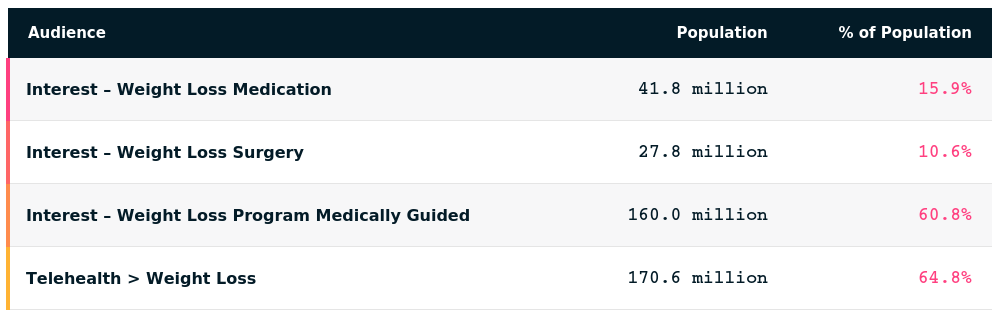
Weight-loss interest breaks down into four distinct national audiences. Causeway Solutions, September 2026.
These audiences are not mutually exclusive, and they do not all measure the same thing. Interest in a specific pathway such as weight-loss medication or surgery is inherently narrower than a broader audience defined around medically guided programs or telehealth and weight loss. That distinction matters because marketing to "people interested in weight loss" as if they were a single audience means combining people with very different levels of interest, specificity, and potential intent. A message broad enough to reach everyone may not be particularly relevant to anyone.
There is also a much smaller audience that signals a more immediate potential action: Likely Consult Doctor about Weight Loss, at 9.8 million people, or 3.7% of the national population. Compared with the broader interest audiences, this group represents a much narrower point of potential intent. For healthcare marketers, that difference is important. A person broadly interested in weight loss is not necessarily in the same place as someone who is already considering talking to a doctor about it.
Interest surged, then softened, right as employer coverage started to pull back
Comparing today's numbers to July 2025 shows something worth watching closely. Interest in weight-loss medication is down modestly since July (from 43.1 million to 41.8 million, roughly 3%), and surgery interest is down a similar amount (from 29.2 million to 27.8 million, roughly 5%). The two broader segments, Medically Guided Program and Telehealth, have stayed essentially flat over the same period.
That's a meaningfully different picture than steady, uninterrupted growth. The narrower, more committed pathways, medication and surgery specifically, have softened slightly after last year's surge, while broader awareness has held.
The timing lines up with a shift happening on the payer side. Employers are increasingly pulling back on GLP-1 coverage for weight loss as drug spending strains benefit budgets: HCA Healthcare has scaled back coverage for some employees, Cigna has reported a broader pullback among large employers, and industry surveys have found employer coverage for weight-loss-specific GLP-1 use holding flat or declining even as diabetes-related coverage continues to grow. None of that proves causation. But a softening in medication and surgery interest arriving at the same moment employers are making GLP-1s harder or more expensive to access is a connection worth naming rather than ignoring, especially for any organization building a weight-loss marketing strategy around continued unconstrained growth in medication demand.
The next opportunity may extend beyond the medication itself
One of the more interesting implications of the Wells Fargo discussion is what long-term GLP-1 management requires. As care shifts toward longitudinal management, there may be greater demand for medication management, monitoring, adherence support, obesity medicine, and other forms of ongoing care, particularly for patients whose coverage is now less certain than it was a year ago.
That creates an opportunity to look beyond the question of who is interested in GLP-1s and ask how people interested in weight loss are engaging with healthcare more broadly.
Our Telehealth > Weight Loss audience provides one lens into that question. When we cross-reference this audience with primary-care behavior, we see some meaningful differences:
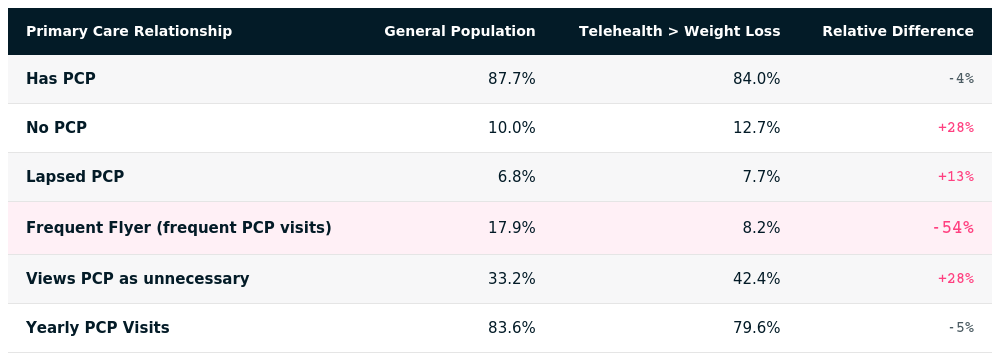
The Telehealth > Weight Loss audience shows a markedly weaker connection to primary care than the general population. Causeway Solutions, September 2026.
The starkest gap is Frequent Flyer status: people in the Telehealth > Weight Loss audience are roughly half as likely as the general population to be frequent primary-care visitors. Combined with lower rates of having a PCP at all and higher rates of viewing a PCP as unnecessary, the pattern is consistent: this audience is meaningfully less connected to traditional primary care than the population overall.
The data doesn't establish that telehealth is replacing primary care. It does, however, suggest that people exploring weight loss through telehealth may be doing so with a thinner, less consistent primary-care relationship behind them, right at the moment when ongoing GLP-1 management increasingly depends on someone monitoring that relationship. If employer coverage keeps tightening, this may be the audience most likely to fall through the gap between wanting to continue treatment and having a provider relationship that supports it.
What this means for healthcare marketers
Whatever is happening at the service-line level inside health systems, and that's a question for a different kind of analysis, the consumer-facing weight-loss market is not one audience today. It includes people interested specifically in medication, people interested in surgery, a much broader group interested in medically guided programs or telehealth, and a smaller audience already indicating a potential intent to consult a doctor. Each represents a different level of specificity and potentially requires a different message, channel, or point of engagement, and now, a different level of exposure to the coverage questions employers are actively reworking.
The opportunity isn't to build one bigger weight-loss audience. It's to understand the audiences within it: who is interested in each pathway, how connected they are to existing primary care, how exposed they may be to shifting employer coverage, and what message is most relevant to where they actually are.
As GLP-1s continue to reshape how people think about weight loss, and as the payer landscape underneath that shift keeps moving, the near-term marketing question isn't necessarily which pathway will win. It's simpler than that: Who is interested in what, right now, and what should they hear next?
Sources
Landi, Heather. "GLP-1s are forcing a strategic reset across healthcare: Wells Fargo report." Fierce Healthcare, August 20, 2026.
"Employer health plans retreat from GLP-1 weight-loss coverage." Modern Healthcare, September 2, 2026.
"Healthy Returns: Employers aren't expanding coverage of GLP-1 obesity drugs, many are finding ways around it." CNBC, July 8, 2026.
CDC/NCHS obesity prevalence data, as cited in the Wells Fargo report: cdc.gov/nchs/products/databriefs/db508.htm
Causeway Solutions national consumer audience data, September 2026, with prior comparison from July 2025.