
What you can learn when you look beyond the label
Football fans are easy to find. What's harder is understanding who they actually are.
A typical audience dataset might tell you that someone is interested in football. Maybe you can add age, gender, income, geography, or a few other standard demographic characteristics.
But what if you could see what else that person follows, how deeply they engage with the sport, what they do around it, and how they consume media?
That's where a broad “football fan” audience starts to get more interesting.
Our national data includes 202.8 million football fans, and looking inside that audience reveals some interesting layers.
1 in 5 football fans are Super Fans
“Football fan” doesn't tell you how invested someone actually is.
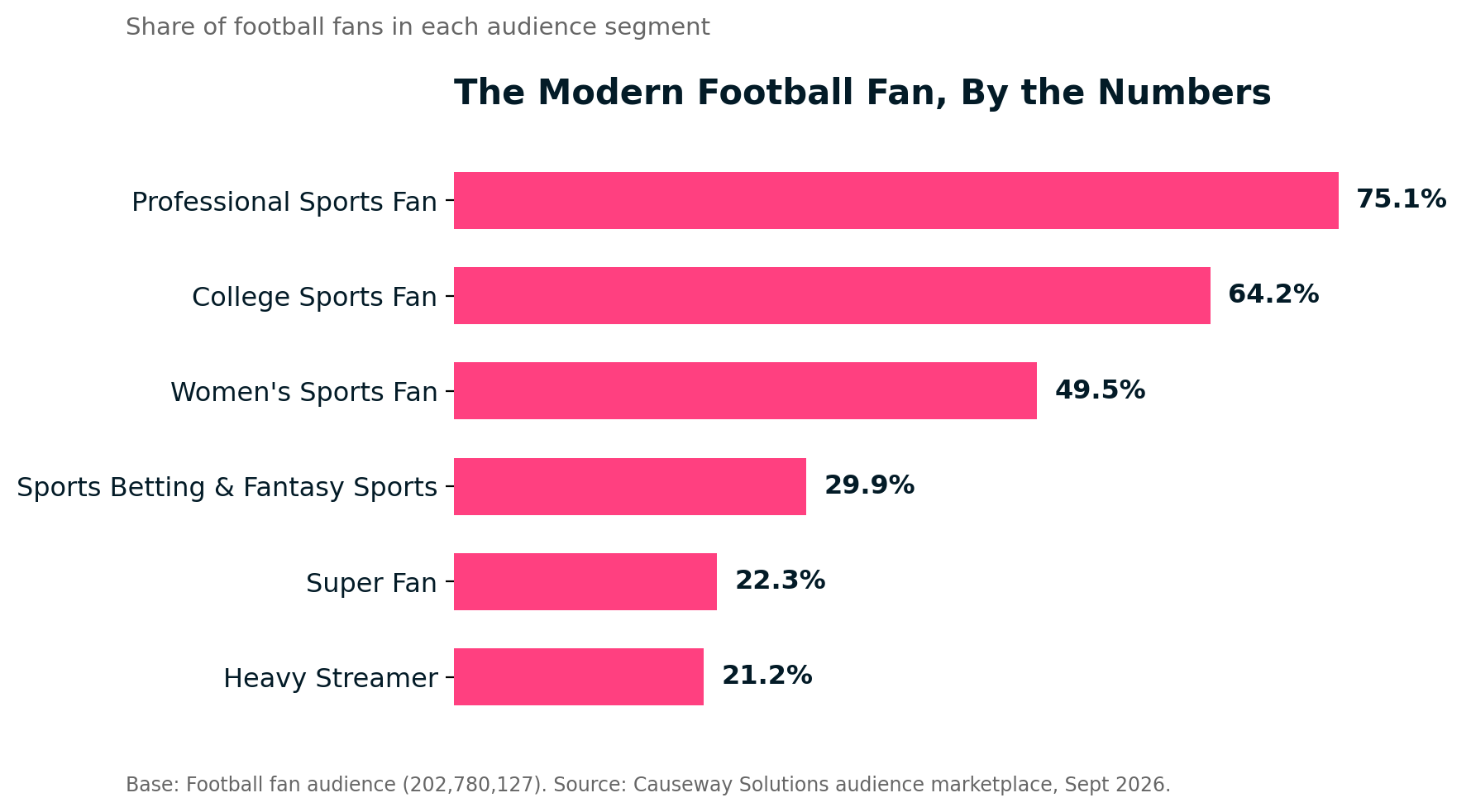
Our Sports Fans data separates football fans by levels of engagement, including Super Fans and Casual Fans. 22.3% of football fans qualify as Super Fans.
That's roughly 1 in 5 people in the audience with a much deeper level of engagement with the sport.
For a marketer, that's an important distinction. A person who casually follows football and someone who is deeply invested in it may both qualify as football fans, but they don't necessarily represent the same opportunity.
The audience label gets you in the door. The engagement data tells you what's inside.
Football fans don't necessarily choose between college and professional sports
Another assumption that can be easy to make is that college football and professional football represent two different audiences.
The data suggests the picture is more complicated.
75.1% of football fans index as Professional Sports Fans, while 64.2% index as College Sports Fans.
The numbers point to significant crossover between the two interests. Football fandom isn't neatly divided into Saturday people and Sunday people.
That's useful context for anyone trying to understand the sports audience as a whole. What looks like two distinct audience segments based on the property may actually contain many of the same people.
Again, the football label doesn't tell you that. The additional audience data does.
Nearly half of football fans also index as Women's Sports Fans
This may be one of the more unexpected findings.
49.5% of football fans index as Women's Sports Fans.
That's nearly half of the football audience showing an affinity that isn't obvious from the football label itself.
It doesn't mean every person in that group has the same level of interest in women's sports. It does show that football fandom exists within a much broader sports ecosystem.
For marketers, that can open up a different way of thinking about sports audiences. Instead of defining someone only by the sport they follow, you can start to see the other interests that may shape their relationship with sports more broadly.
Football fandom extends beyond watching the game
Some of the most useful audience signals aren't about what people watch at all.
29.9% of football fans participate in Sports Betting & Fantasy Sports.
That's nearly 3 in 10 people in the football audience participating in activities built around the sport.
For the right brand, that behavioral signal can be much more informative than football affinity alone. A company operating in sports, entertainment, gaming, food delivery, travel, financial services, or another football-adjacent category may have a very different reason to reach someone who participates in betting or fantasy sports.
The point isn't that betting and fantasy participation makes someone a better football audience for every campaign.
It's that behavior gives marketers another way to define relevance.
And some football fans aren't primarily watching on traditional television
The same principle applies to media consumption.
21.2% of football fans qualify as Heavy Streamers.
A football audience isn't automatically a broadcast audience.
That distinction matters as sports viewing continues to spread across different media environments. If you're trying to understand how to reach a particular audience, knowing what they watch is only part of the equation. Knowing how they consume media can help tell you where that audience may be found.
The sport creates the common interest.
The media behavior reveals another layer.
What a football audience looks like when you look inside it
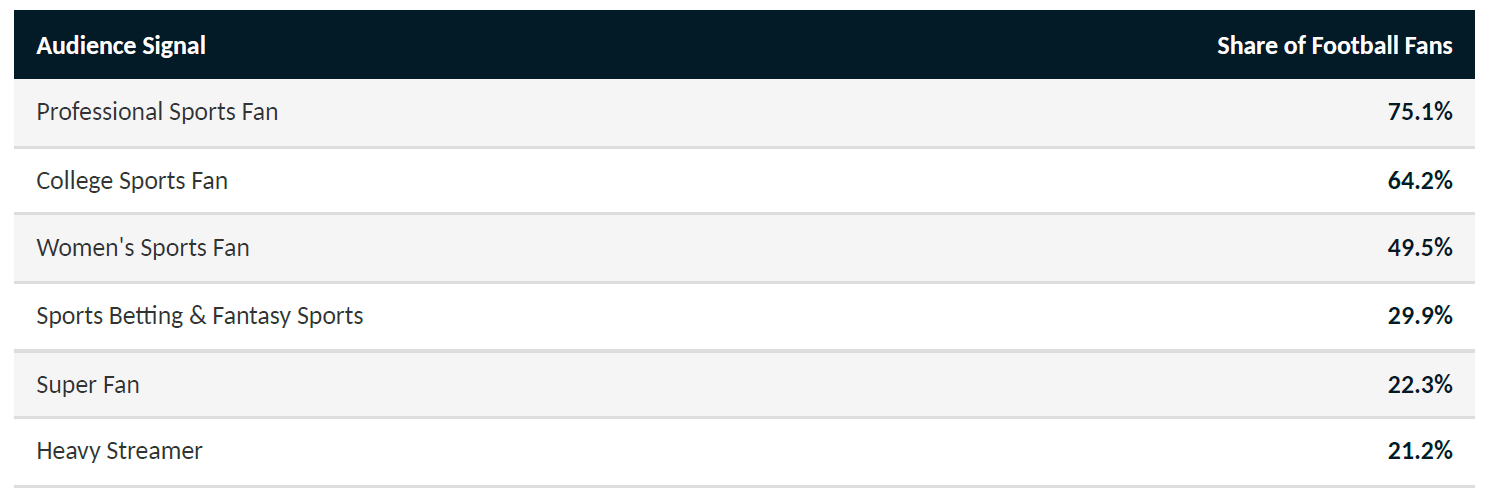
These numbers aren't six separate audiences, and they aren't meant to be added together. They're different characteristics that exist within the same 202.8 million-person football audience.
And that's the bigger point.
"Football fan" is useful as a starting point. But by itself, it doesn't tell you much about the person you're trying to reach, or whether reaching them is worth what you're paying to do it.
Layer in sports affinity, engagement, behavior, and media consumption, and the label starts to split into decisions: who's worth a premium placement, who's likely to respond to a betting or fantasy sports offer, who you're missing entirely if your plan is broadcast-only, and who's simply along for the ride.
That's the difference between buying football and buying the specific football fans who are worth your budget.
For a media buyer, it's the difference between pricing placement on reach alone and pricing in which fans inside that reach are actually worth a premium. For a strategist, it's building a plan around which fans inside the audience should be driving the message, not just briefing 'target football fans.'
The label tells you someone likes football. The data tells you what that's worth, and to whom.
Data segments referenced: Sports Fans (Football, Super Fan/Casual Fan), College Sports Fan, Professional Sports Fan, Women’s Sports Fan, Sports Betting and Fantasy Sports, Streaming (Heavy Streamer). Base: Football fan audience (202,780,127).