
Beyond GLP-1: Rethinking Your Endocrinology Service Line

Three numbers that should shape your next endocrinology campaign.
Endocrinology isn't just diabetes and thyroid anymore. GLP-1, hormones, and weight management are all reshaping the patient funnel of this service line.
With nearly 10 million people in the U.S. likely seeking endocrinology care, the real shift isn’t just scale, it’s composition. The rise of GLP-1 medications has introduced a new wave of patients into the category, many of whom don’t look or behave like traditional endocrinology audiences.
Millions of people exploring GLP-1 options also fall into broader endocrinology needs like diabetes management, thyroid disorders, hormone therapy, yet most campaigns treat this as a single, uniform audience.
As a result, marketing strategies are often built on static profiles instead of actionable segmentation. They describe who the patient is, but not how to reach them, when to engage, or what message will actually drive action.
Health systems that recognize this early shift and adjust their strategy accordingly have a clear opportunity to capture demand before competitors do.
Marketing for Two Different Patients
The issue isn’t awareness, it’s misalignment. And the first mistake most health systems make is treating endocrinology patients as a single group. The data points to at least two distinct segments that require different creative, different channels, and different timing.
The first is older, lower-income, and likely managing an existing condition such as diabetes or a thyroid disorder. This group skews 65+, is predominantly female, and nearly half fall under $50K in household income, and over-indexes in Medicare Advantage. These patients are already in the system and see their primary care provider regularly to actively manage their condition.
For this audience, marketing isn’t about discovery. It’s about access, continuity of care, and navigation. Messaging that emphasizes ease of scheduling, care coordination, and insurance clarity will outperform traditional awareness campaigns.
The second segment is younger, commercially insured, and earlier in the diagnostic journey. Many are self-referring prompted by bloodwork, symptoms, or researching GLP-1 options independently. They are more convenience-driven, more digitally responsive, and more likely to compare providers.
This is also a segment most at risk for leakage. If your health system isn’t visible early, when they begin researching options, you’re likely to lose them to competitors who are.
Messaging: Lead with access, not relationship
Connection is still a driver of care for decisions, but for this audience it’s not the primary one. Compared to national benchmarks, endocrinology patients in this category are less relationship driven and more motivated by convenience and access.
That means messaging should shift accordingly:
Speed to appointment
Ease of entry into the system
Clear next steps
Health systems that continue to lead with brand and reputation alone risk missing what actually moves this audience to act.
Channel strategy: Digital-only is structurally missing this audience
The highest-propensity patients in this audience skew older, predominantly female, and over-index in linear TV and cable. A digital-only plan doesn't just underperform; it will fail to reach a meaningful portion of this audience altogether.
The most effective channel mix reflects how these segments actually consume media:
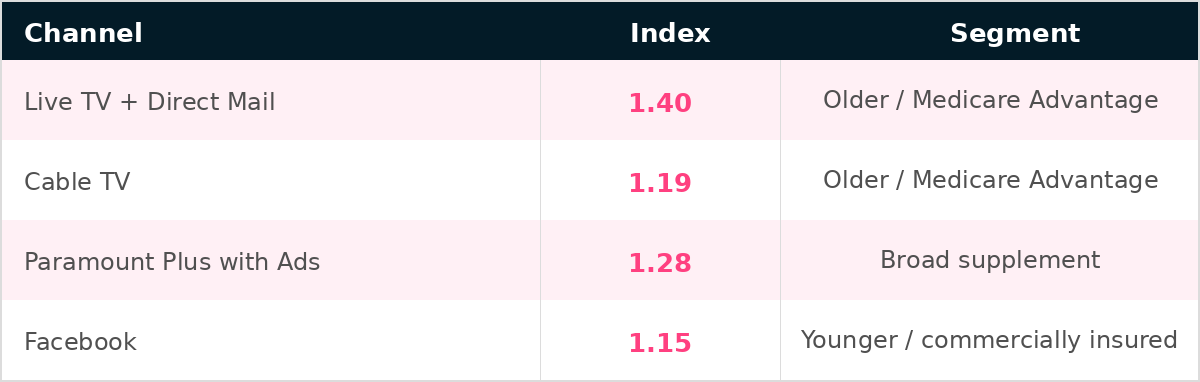
Most campaigns default to digital only because it is easier to measure, but that is not the same thing as being more effective.
Timing: The second opinion stat is a conquest opportunity hiding in plain sight
Almost 2 million people in this audience are actively seeking a second opinion. That is not a satisfied patient population. That is a group that is already questioning their current care and open to switching providers.
General awareness creative will not move this group. They are looking for reasons to trust a new provider.
Specifically, this segment is looking for:
Proven outcomes
Specialist expertise
Fast, clear access to care
If you’re not running a distinct campaign for this group, you’re leaving high-intent patient volume on the table.
More broadly, timing is the overlooked lever across this entire funnel. By the time many patients are searching for an endocrinologist, they are already mid-journey. The biggest opportunity is reaching people earlier, at the primary care or symptom-awareness stage, before a preference is formed.
That requires a shift from retargeting based on digital interests to predictive identification - finding the people most likely to need care in the next 6 to 12 months and engaging them before a decision is locked in.
Before you finalize the brief
Before launching your next endocrinology campaign, pressure test a few assumptions:
Are you treating this as one audience, or at least two distinct segments?
Is your messaging built around access and action, not just brand?
Does your channel mix reflect actual media consumption or what’s easier to measure?
Are you targeting patients already in-market (second opinion) and influencing them earlier in their journey?
If the answer to any of those is no or not sure, that is worth a conversation. Causeway works with health system marketing teams to build the strategy before the campaign brief is written. Reach us at info@causewaysolutions.com.
Source: Causeway Solutions Audience Intelligence Report: Endocrinology - Diabetes. Data is derived from proprietary audience modeling.