
Part Two of The New Persuasion Series | By Alexis Valdez Darnell, Causeway Solutions
In Part One of this series, we established that persuasion alone is no longer a complete strategy. The margins are too tight, the targeting universes too saturated, and the competition for truly undecided voters too symmetrical to rely on a single lever.
So what is the alternative?
It starts with looking at who is already there.
The Reinforcement Gap
There is a measurable population in nearly every competitive district that standard targeting models consistently overlook. They are not undecided voters. They are not classic swing voters. They are not high-propensity base voters either.
They are voters who are already aligned on the issues that drive the outcome of a specific race — registered but inconsistent in turnout, located disproportionately in competitive geographies, and rarely prioritized because they do not score as persuasion targets.
We call this the reinforcement gap. Campaigns have always known this group exists. Now we can find them.
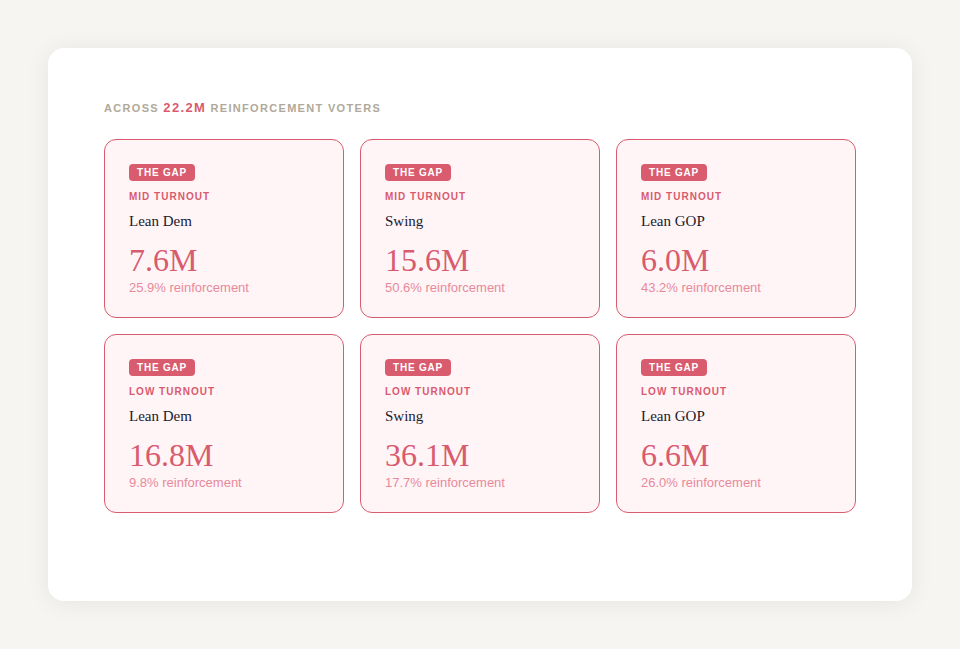
The scale here is significant. Causeway Solutions data identifies 22.2 million reinforcement voters sitting in mid- and low-turnout universes across Lean and Swing segments — voters whose participation is conditional, issue-responsive, and not consistently activated by current engagement strategies. Nationally, this universe often exceeds the margin needed to win in close districts. And yet it remains one of the most undervalued strategic assets in the electorate.
Source: Causeway Solutions Electoral Intelligence, 2025.
Why Legacy Models Miss Them
Most legacy models deprioritize these voters because past turnout behavior is overweighted in scoring systems. If someone did not vote in the last cycle, they frequently fall down the targeting stack — even if they are highly aligned on the issues that drive the outcome of a specific race.
These voters sit primarily in mid- and low-turnout universes across Lean and Swing segments. Their participation is conditional, often driven by issue salience, relevance, or mobilization quality rather than partisan identity alone.
They are not broadly disengaged. They are selectively engaged. And that distinction matters enormously for how you reach them.
Issue Alignment is the Key Variable
Issue alignment often predicts activation more reliably than partisan score among mid- and low-propensity voters. The data makes this concrete.
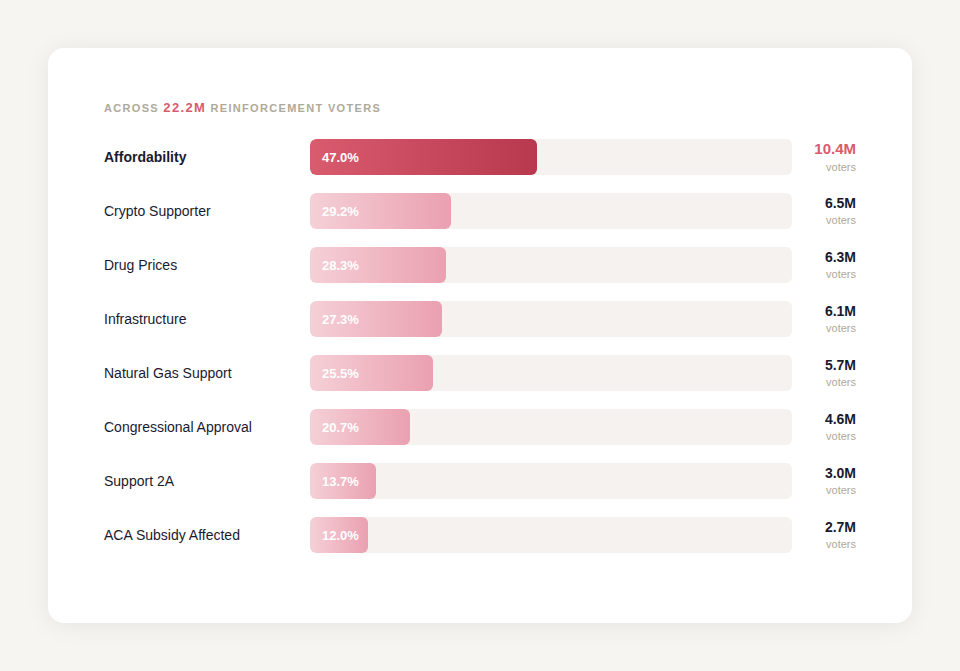
Across the 22.2 million reinforcement voters, issue-specific alignment is measurable and concentrated. Affordability is the dominant driver, with 47% — roughly 10.4 million voters — aligned on that issue. From crypto support to drug prices to Second Amendment alignment, each issue segment represents millions of distinct, targetable voters.
Source: Causeway Solutions Electoral Intelligence, 2025.
The takeaway from that data is pointed: the electoral gap can be closed without persuading the entire electorate. It is driven by activating relatively small, issue-responsive populations located in structurally decisive segments.
When programs over-index on persuasion universes, they often spend heavily to move a small percentage of truly undecided voters who are also being targeted equally by the opposition. Meanwhile, this larger, issue-aligned group goes unaddressed because it requires activation rather than persuasion. Those are different strategies, and conflating them is where budget gets lost.
Who They Are: A Demographic Profile
Understanding the reinforcement voter population requires more than a topline number. The demographic profile of these voters reveals why standard models miss them — and why issue-specific targeting can unlock them.
Reinforcement voters skew slightly younger than the national electorate, with stronger representation in the 25-44 range. They are roughly gender-balanced overall, though issue subsets diverge sharply — the prescription drug prices segment is 71.2% female, while the crypto supporter segment is 91.7% male. Same universe, completely different audiences depending on the issue lens applied.
On party registration, the most defining feature is unaffiliation. More than half — 54.4% — are registered Other/Unaffiliated, compared to just 29.3% of the national electorate. These are not base voters hiding in plain sight. They are structurally outside the conventional targeting frame, which is exactly why standard models miss them.
Where The Gap Shows Up: Target Districts
The national picture is instructive, but the reinforcement gap becomes most consequential at the district level — where small shifts in participation can determine outcomes.
Consider prescription drug prices as a single issue lens. In NJ-7, where the 2024 result was R+5, there are 14,883 prescription drug price reinforcement voters available — against a reinforcement need of only 2,505 to flip the outcome. In IA-3 (R+4), 9,268 are available against a need of 5,641. In PA-7 (R+1), 14,033 are available against a need of 5,481.
The crypto supporter lens shows similar leverage. In CO-8 — decided by just R+0.7 in 2024 — 21,219 crypto-aligned reinforcement voters are available, nearly 16.7% of the winner target. In IA-1 (R+0.2), 10,726 are available. In WA-3 (D-4), 11,017 are available against a reinforcement need of 10,811 — a gap of just 206.
These are not theoretical opportunities. They are measurable populations, located in real districts, activated by specific issues, sitting outside conventional targeting models.
What It Takes To Find Them
Identifying reinforcement audiences requires more than standard voter file overlays. It requires updated modeling that captures issue alignment and behavioral nuance, geographic stratification that reflects political and turnout variation, and integration of consumer and modeled data beyond legacy predictors.
This often costs more upfront. It takes more time. But consider the alternative. If a race will be decided by 5,000 to 10,000 votes, and you have spent your budget chasing undecided voters who are being targeted equally by the opposition, you have not played it safe. You have left the outcome to chance.
The reinforcement gap is not a niche opportunity. It is the difference between a program that moves the needle and one that spins its wheels. These voters are already with you on the issues. They are registered. They are reachable. The only question is whether your targeting model is built to find them — or built to ignore them.
Stay tuned for Part Three of The New Persuasion Series, where we examine a real-world application of the reinforcement gap framework and what it looks like in practice through one of the most consequential issues of the 2026 cycle.
About the Author
Alexis Valdez Darnell is a National Insight Marketing Strategist at Causeway Solutions. She works with advocacy, government affairs, political, and community engagement teams. Her work focuses on applying behavioral modeling to high-stakes environments where small shifts in participation can determine results. Reach her at alexis.darnell@causewaysolutions.com.